Farm Direct Website
Sevenstones Farms is a group of local Devon farms who have come together to showcase and sell their meat and produce direct to the public.
Key Features
- WordPress
- Kadence
- MailerLite Integration
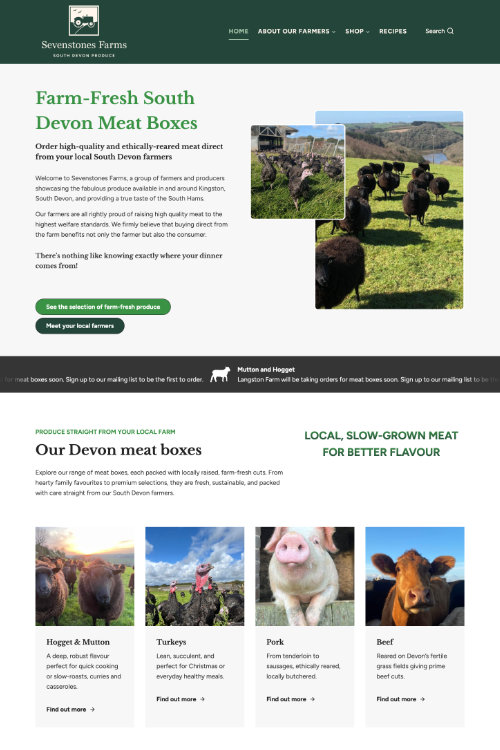
It’s always more enjoyable to work on a website when the client is passionate and their ethos is one that I wholeheartedly support on a personal level. The Sevenstones Farms project was exactly that. We live in an age where most people have little idea where their food comes from, how far it has travelled, or what kind of life the animal had before it reached their plate. The farm direct model cuts through all of that. You know the farm, you know the farmer, and you know the land. The food is fresher, the provenance is transparent, and the money goes direct to the people who actually produced it rather than disappearing into a supermarket supply chain. A website that helps make that connection happen more easily is, to my mind, a genuinely worthwhile thing to build.
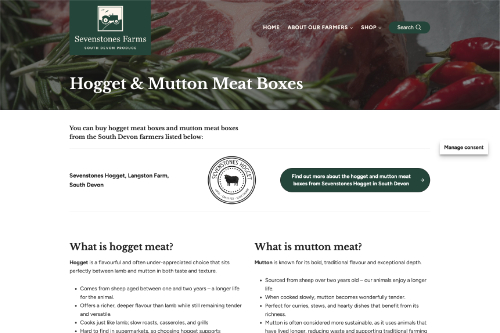
Sevenstones Farms is the online home of a collective of local farmers who have come together to sell their produce directly to the public. Currently centred around meat boxes, the collective is growing — bread, milk and vegetable boxes are in the pipeline as more South Devon farmers join — and the site is designed to grow with them.
Start by asking questions
One of the first things I do with any new client is to think carefully about what the website actually needs to accomplish, not in vague terms, but in specific, concrete ones. For Sevenstones Farms that meant working through three questions in particular.
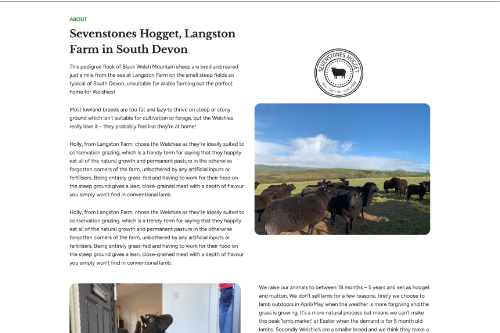
What does a visitor need to know immediately? When someone lands on this site for the first time, they might have arrived via a search, a social media post, or a recommendation from a neighbour. Whatever brought them there, they need to understand within a few seconds what this is, who it’s from, and why it matters. For Sevenstones Farms, the answer is straightforward but important: local farmers, quality produce, sold direct. That message needed to be front and centre — not buried beneath beautiful photography or lost in lengthy prose, however well-written.
What story does the farmer need to tell? Selling direct to the public isn’t just a transaction, it’s a relationship. Customers who buy a meat box from a farm collective aren’t just purchasing meat; they’re choosing to know where their food comes from, how the animals were raised, and who looked after them. That story is a fundamental part of the project.
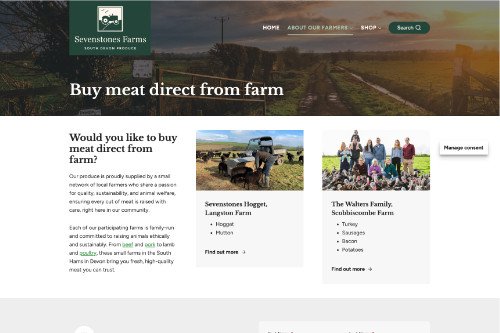
What actions does the visitor need to take? This is the question that shapes everything from navigation to calls to action. Sevenstones Farms is not a conventional e-commerce site: because availability changes with the seasons and the farming calendar, produce isn’t always available to buy immediately. Instead, the site is designed to capture interest and open a direct line of communication between customer and farmer. A visitor who wants a meat box gets in touch, tells the farmer what they’re after, and the farmer comes back to them with what’s available now and what’s coming soon. That model required careful thought about how to guide visitors towards making contact without making it feel like a barrier — the journey needed to feel warm and personal, not like filling in a form.
Getting the SEO right from the beginning
Because this was a brand new site with no existing search presence to build on, SEO wasn’t an afterthought. It needed to be considered very early on. Because I felt it was so important to get this right, I enlisted the services of Jennie Hawkins, a local copywriter and SEO specialist to assist with this.
She identified the keywords that prospective customers in the area were most likely to use when searching for local farm produce: the terms that would actually drive the right kind of traffic rather than just any traffic and that research helped to shape the home page design. Jennie made recommendations on where to place these keywords and how to weave them into the heading and copy in way that invites the customer to take action and also achieve a decent ranking in the search engine results pages.
Good SEO and good writing aren’t in conflict; when done properly, they reinforce each other. Getting an SEO specialist involved at the design stage, rather than asking them to work with a finished site, made a real difference to what we were able to achieve.
A website built to grow
One of the key considerations for this project was the website would grow. As new farmers join the collective, new produce categories will be added. The site, built with WordPress, is structured to accommodate that growth without requiring a redesign every time something new comes on board. A baker bringing bread to the collective, a dairy farmer offering milk, a grower arriving with vegetable boxes — each of these can be added cleanly and consistently as the project develops.
That scalability was a conscious design decision, not a happy accident. Understanding where a client wants to be in two or three years, not just right now, is part of what I bring to every project.
Interested in something similar?
If you’re a farm, food producer, or small collective thinking about how to sell direct to your customers and tell your story online, I’d love to talk. The Sevenstones Farms project is a good example of what’s possible when the brief is approached thoughtfully — a site that works hard commercially while staying true to the values of the people behind it.